

NVIDIA BioNeMo Platform Adopted by Life Sciences Leaders to Accelerate AI-Driven Drug Discovery
News Summary:
- Lilly and NVIDIA launch AI co-innovation lab to tackle drug discovery challenges.
- NVIDIA collaborates with Thermo Fisher to build autonomous lab infrastructure for scalable scientific discovery.
- Chai Discovery, Basecamp Research, Boltz and ecosystem leaders connect NVIDIA BioNeMo, agentic AI and physical AI to scale science and drug discovery.
SAN FRANCISCO, Jan. 12, 2026 (GLOBE NEWSWIRE) -- J.P. Morgan Healthcare Conference -- NVIDIA today announced a major expansion of NVIDIA BioNeMo™, an open development platform that enables lab-in-the-loop workflows to develop breakthroughs in AI-driven biology and drug discovery.
The life sciences industry generates vast amounts of scientific data. BioNeMo provides the development platform to generate and process data, train, optimize and deploy models — enabling the industry to turn data into a competitive engine for discovery and maximize the probability of success while minimizing R&D costs, which are currently estimated at $300 billion a year.
BioNeMo has now expanded to include:
- New NVIDIA Clara™ open models, the RNAPro model for RNA structure prediction and the ReaSyn v2 model for ensuring AI-designed drugs are practical to synthesize.
- BioNeMo Recipes to easily accelerate and efficiently scale biological foundation model training, customization and deployment.
- BioNeMo data processing libraries such as nvMolKit, a GPU-accelerated cheminformatics tool for molecular design.
“Biology and drug discovery are reaching their transformer moments,” said Kimberly Powell, vice president of healthcare at NVIDIA. “BioNeMo turns experimental data into usable intelligence for AI, so every experiment informs the next. This creates a continuous learning cycle that speeds up discovery and helps researchers build new frontier models to tackle some of biology’s toughest challenges.”
NVIDIA is collaborating with leading life sciences organizations to integrate BioNeMo with laboratory experiments and scientific workflows, enabling the full AI lifecycle for biology and drug discovery — closing the loop between experimentation and AI.
Today, Lilly announced a first-of-its-kind collaboration with NVIDIA to launch a co-innovation lab focused on tackling some of the most enduring challenges in drug discovery. In parallel, Thermo Fisher announced a collaboration with NVIDIA aimed at making scientific instruments intelligent and laboratories increasingly autonomous.
Lilly and NVIDIA Announce Landmark Co-Innovation AI Lab
NVIDIA and Lilly’s collaboration will bring the companies’ respective talents together, integrating NVIDIA’s accelerated computing, AI and robotics expertise with Lilly’s world-renowned drug discovery and development proficiency. This will help Lilly pursue challenges that could revolutionize drug discovery, as the NVIDIA BioNeMo platform and Lilly’s agentic lab support Lilly chemists and biologists. The companies will also explore opportunities to apply accelerated computing and advanced AI across Lilly’s business, from manufacturing to commercial operations.
Standing up this co-innovation lab follows the buildout of Lilly’s NVIDIA DGX SuperPOD™ and AI factory, the most powerful in biopharma. The new initiative expands beyond this existing footprint and intends to harness investments in next-generation NVIDIA architectures, including Vera Rubin — representing a total investment of up to $1 billion expected in talent, infrastructure and compute over five years.
“We see this as a catalyst for the capabilities that will define the next era of drug discovery,” said Diogo Rau, executive vice president and chief information and digital officer at Lilly. “By working with NVIDIA, we’re uniting massive compute, specialized talent and the ability to shape data at immense scale. We’re moving toward a future where discovery is driven by rapid experimentation and increasingly customized models — an approach that reflects our commitment to leading applied AI in drug discovery and investing deeply in new forms of data generation and model development.”
Thermo Fisher Teams With NVIDIA to Build Autonomous Lab Infrastructure for Scalable Scientific Discovery
By integrating NVIDIA’s full-stack AI computing with Thermo Fisher’s industry-leading instrumentation, the companies’ collaboration aims to transform scientific research labs into scalable, automated data factories, including through:
- Unified Edge-to-Cloud AI Compute: Tapping into the NVIDIA DGX Spark™ desktop supercomputer to orchestrate autonomous lab workflows, providing a seamless computing fabric from the laboratory edge to the cloud for high-throughput experiment management.
- Multi-Agent Systems for Lab Orchestration: Using the NVIDIA NeMo™ software suite to develop agentic workflows that can autonomously generate protocols, run experiments and perform real-time quality control without continuous human intervention.
-
Autonomous Data Analysis: Integrating BioNeMo tools to provide real-time, autonomous interpretation of instrument outputs, accelerating the transition from raw data to actionable scientific insight.
“Artificial intelligence coupled with laboratory automation will transform how scientific work is performed,” said Gianluca Pettitti, executive vice president of Thermo Fisher Scientific. “By combining Thermo Fisher’s leadership in laboratory technologies with NVIDIA’s AI solutions, we can help customers work faster, improve accuracy and get more value out of each experiment, ultimately accelerating discoveries that can have significant human impact.”
The NVIDIA-Powered AI Drug Discovery Ecosystem
Across the globe, innovators are building the future of AI for drug discovery on the BioNeMo platform, allowing developers to take an industrial-scale, AI-driven approach to understanding biology and designing potential medicines.
Model builders across biotech and drug discovery using BioNeMo to scale model training and development include:
- Basecamp Research, which introduced the EDEN family of AI models for drug design, including a system capable of precisely inserting large DNA segments, a long-standing challenge in genetic medicine.
- Boltz PBC, which launched Boltz Lab, a software platform for AI-driven molecular design.
- Chai Discovery leverages BioNeMo to accelerate biomolecular foundation model development and deployment.
-
Natera, which announced its proprietary AI foundation model platform to facilitate drug discovery and design, built on its unique and extensive genomic and clinical cancer dataset.
Apheris, Dyno Therapeutics, OpenFold and Terray Therapeutics have also recently released models developed using the BioNeMo platform.
AI Scientists Building Digital Labs of the Future
Aggregating scientific data and building agentic workflows to analyze data, generate hypotheses and design experiments is essential for accelerating scientific discovery.
A growing ecosystem of AI scientist companies are developing on NVIDIA open models and the NVIDIA NeMo framework to build domain-specific agents for science, including:
- Edison Scientific recently released Kosmos, an AI scientist for autonomous discovery that can do six months of work overnight.
- Tetrascience announced a collaboration with Thermo Fisher Scientific to advance open, interoperable, industry-aligned AI workflows and is integrating NVIDIA Nemotron™ open models to extract scientific knowledge from graphs, charts and figures.
-
Owkin announced OwkinZero, a frontier biology model — trained on expansive patient data — built for biological discovery.
Other companies adopting NVIDIA NeMo and NVIDIA NIM™ microservices for AI science include Benchling, CytoReason, HelixAI (a Sapio Sciences company) and Potato.
Connecting these digital agentic systems into the physical lab closes the loop between in-silico experimentation and real-world validation.
NVIDIA is working with an ecosystem of robotics and lab automation companies to introduce simulation and physical AI technologies:
- Multiply Labs is building robotic digital twins with the NVIDIA Isaac Sim™ framework to validate and test robots before deployment in biomanufacturing, as well as using NVIDIA Isaac GR00T models to train new manipulation skills.
- Lila Sciences, a company building Scientific Superintelligence, is scaling every step of the scientific method, using automated labs to generate data and validate experiments designed by its AI system.
- HighRes Biosolutions is using NVIDIA Isaac Sim for simulation-first lab automation design and the NVIDIA Cosmos-Reason1 model to allow robots to interact in real time to adjust experiments.
- Opentrons Labworks, a lab automation company, is using Isaac Sim to train robots so they can operate beyond constrained environments, supporting AI-driven workflows that connect digital agents to physical lab operations.
Other companies including Amgen, Automata, Roche and Transcripta Bio have built digital twins using NVIDIA Omniverse™ libraries and Isaac Sim to bring physical AI to labs and manufacturing facilities.
Learn more about how the NVIDIA BioNeMo platform supports AI-driven biology and drug discovery.
About NVIDIA
NVIDIA (NASDAQ: NVDA) is the world leader in AI and accelerated computing.
For further information, contact:
Janette Ciborowski
NVIDIA Corporation
+1-734-330-8817
jciborowski@nvidia.com
Certain statements in this press release including, but not limited to, statements as to: biology and drug discovery entering their transformer moment — where AI is enabling a shift from discovery by chance to discovery by design; with BioNeMo, NVIDIA providing the foundation to industrialize generative AI and tackle biology’s most complex challenges; the benefits, impact, performance, and availability of NVIDIA’s products, services, and technologies; expectations with respect to NVIDIA’s third party arrangements, including with its collaborators and partners; expectations with respect to technology developments; and other statements that are not historical facts are forward-looking statements within the meaning of Section 27A of the Securities Act of 1933, as amended, and Section 21E of the Securities Exchange Act of 1934, as amended, which are subject to the “safe harbor” created by those sections based on management’s beliefs and assumptions and on information currently available to management and are subject to risks and uncertainties that could cause results to be materially different than expectations. Important factors that could cause actual results to differ materially include: global economic and political conditions; NVIDIA’s reliance on third parties to manufacture, assemble, package and test NVIDIA’s products; the impact of technological development and competition; development of new products and technologies or enhancements to NVIDIA’s existing product and technologies; market acceptance of NVIDIA’s products or NVIDIA’s partners’ products; design, manufacturing or software defects; changes in consumer preferences or demands; changes in industry standards and interfaces; unexpected loss of performance of NVIDIA’s products or technologies when integrated into systems; and changes in applicable laws and regulations, as well as other factors detailed from time to time in the most recent reports NVIDIA files with the Securities and Exchange Commission, or SEC, including, but not limited to, its annual report on Form 10-K and quarterly reports on Form 10-Q. Copies of reports filed with the SEC are posted on the company’s website and are available from NVIDIA without charge. These forward-looking statements are not guarantees of future performance and speak only as of the date hereof, and, except as required by law, NVIDIA disclaims any obligation to update these forward-looking statements to reflect future events or circumstances.
Many of the products and features described herein remain in various stages and will be offered on a when-and-if-available basis. The statements above are not intended to be, and should not be interpreted as a commitment, promise, or legal obligation, and the development, release, and timing of any features or functionalities described for our products is subject to change and remains at the sole discretion of NVIDIA. NVIDIA will have no liability for failure to deliver or delay in the delivery of any of the products, features or functions set forth herein.
© 2026 NVIDIA Corporation. All rights reserved. NVIDIA, the NVIDIA logo, BioNeMo, DGX Spark, NVIDIA Clara, NVIDIA DGX SuperPOD, NVIDIA Isaac Sim, NVIDIA NeMo, NVIDIA Nemotron, NVIDIA NIM and NVIDIA Omniverse are trademarks and/or registered trademarks of NVIDIA Corporation in the U.S. and other countries. Other company and product names may be trademarks of the respective companies with which they are associated. Features, pricing, availability and specifications are subject to change without notice.
A photo accompanying this announcement is available at https://www.globenewswire.com/NewsRoom/AttachmentNg/42978041-d588-4465-a0f0-d11fdfff026a

NVIDIA BioNeMo
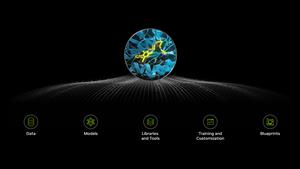
NVIDIA today announced a major expansion of NVIDIA BioNeMo, an open development platform that enables lab-in-the-loop workflows to develop breakthroughs in AI-driven biology and drug discovery.
Legal Disclaimer:
EIN Presswire provides this news content "as is" without warranty of any kind. We do not accept any responsibility or liability for the accuracy, content, images, videos, licenses, completeness, legality, or reliability of the information contained in this article. If you have any complaints or copyright issues related to this article, kindly contact the author above.
